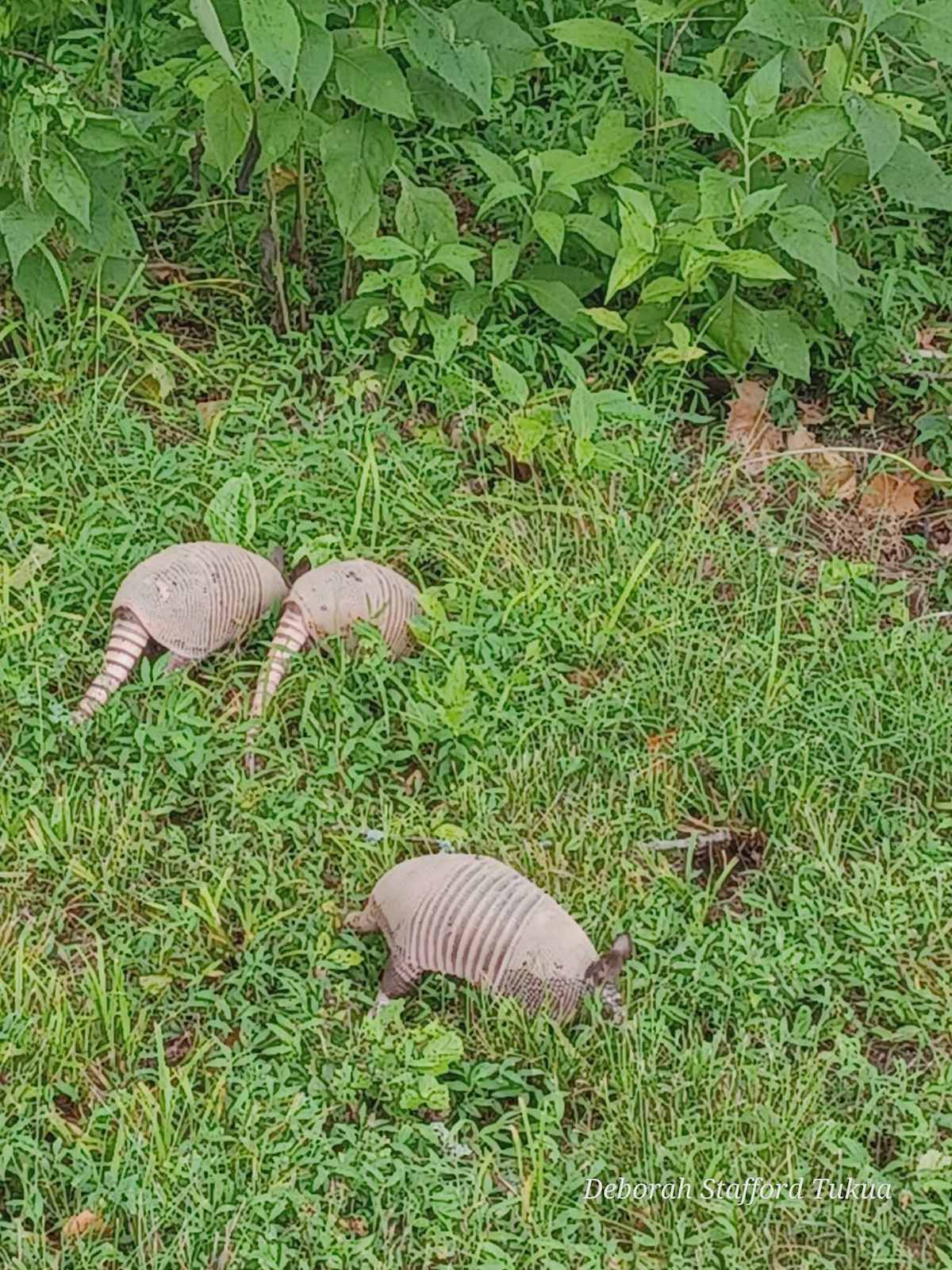
Along Holly Creek, we never know what wild animals we’ll see next. During a recent dinner, my husband glanced out the window, and asked, “What are those?” There were five small creatures, heads down, rooting around in the grass beneath several trees. I headed outside and discovered they were young armadillos. I walked toward them without any trouble as they were busy foraging for food. Since armadillos can’t see or hear well it was easy to get a look, closeup.
Standing only a few feet away, I took a quick video and called the grandkids over to watch them too. Firsthand, outdoor nature moments are unforgettable treasures, especially when shared with inquisitive grands.
The next morning, I saw a mother armadillo leading a row of tiny pups through our grassy field. Its a wonderful wild kingdom everywhere we look this spring. And we love every minute of it.
Fun Facts About Armadillos
1. Armadillo (In Spanish it’s pronounced ahr-mah-DEE-yoh) It means “little armored one.”
2. There are 20 different species of armadillos found in Central and South America. In the United states, there is only one species. The nine-banded Armadillo primarily lives in the southeastern part of the US. Texas has the largest population of nine-banded Armadillos in the US. In fact, armadillos have been adopted as the official state of Texas, small mammal.
3. Baby armadillos are called pups. They are typically born in spring, with their eyes open, and can walk within a few hours. Their armored bodies are soft and leathery at birth, hardening over time into bony plates. These wild mammals are born in burrows, and remain there, under their mother’s care for the first few weeks of life.
4. After a few weeks, young armadillos follow their mothers out of the burrow and learn to forage for food.
5. They are considered fully grown between 9 and 12 months old.
6. In the wild, their average life expectancy is 12-15 years.
7. Poor eyesight and hearing make it easy to observe them feeding in the evenings before dark.
8. Having a keen sense of smell, Armadillos sniff ants or termites in rotting logs, as well as grubs, earthworms, and insects six or more inches below the soil. They also eat frogs and lizards.
9. They have short legs but move quickly when they run. These short creatures stand upright on their hind legs briefly to sniff the air for approaching predators.
10. Long, sharp claws enable them to dig their burrows, and to reach insects several inches beneath the soil.
11. They’re considered nocturnal animals, but they have crepuscular tendencies. We see armadillos feeding in the grass in the evenings before dark and in the morning daylight.
12. When startled, they jump several feet, straight up into the air. This reaction frightens predators like coyotes away, but when it occurs while crossing a roadway, it often ends in their demise as they hit the undercarriage of moving vehicles.
13. And the best fun fact of all– Armadillos can hold their breath for up to six minutes and walk underwater when crossing streams. I would so love to witness one crossing our creek bed underwater.
Leprosy from Armadillos. Myth or Risk?
If you’ve heard that armadillos can transmit leprosy (Hansen’s disease) and other diseases to humans, it’s not a myth. Armadillos can naturally carry the bacteria. Leprosy can be contracted through touch, digesting the meat, or even touching the ground they’ve disturbed. Cases are reported in Florida and other southern states each year.
Leprosy can cause nerve damage, paralyses of the hands and feet, and disfigurement of the body. While the risk of contracting leprosy is not great in the US, caution should be taken to avoid direct contact with the animals. Wear gloves when working the soil where armadillos have been sighted. Thankfully, leprosy colonies in this country are a thing of the past, as the disease is treatable with antibiotics.
Another Myth Buster – The nine-banded armadillo, the US species, cannot roll into a tight ball. (Only the three-banded armadillo can.)
What wild, baby animals have you seen this spring?
By Deborah S. Tukua, author